
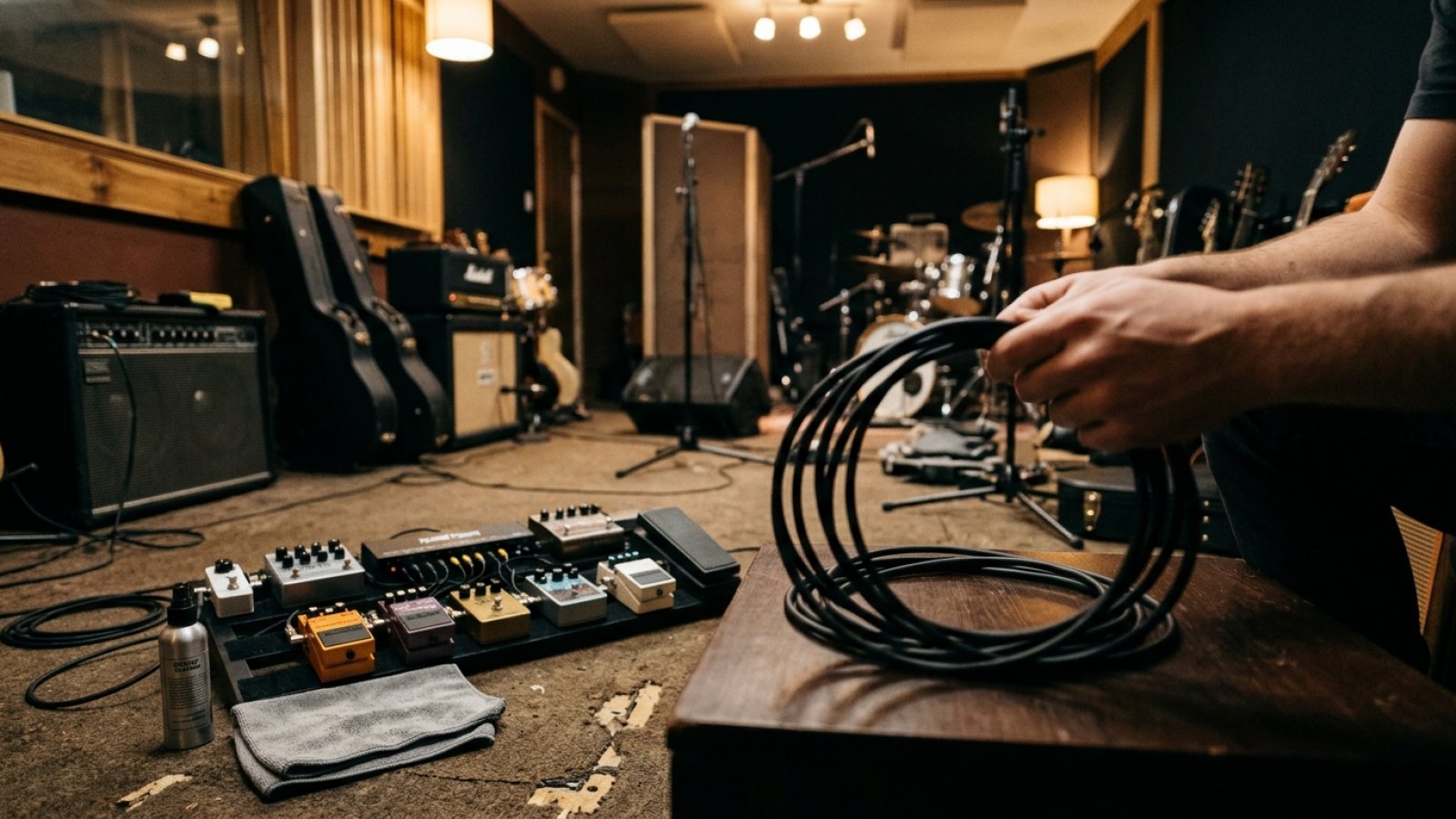
Road-Ready Rig: Master Cable Wrap and Pedalboard Care
Consistent habits for cable wrapping and pedalboard maintenance can prevent unexpected failures. These practices extend the life of your gear and keep your focus on the music.
On a gigging night, the last thing any musician needs is a piece of gear failing right before a downbeat or in the middle of a set. Many common failures aren't about faulty manufacturing; they're the slow, grinding wear from everyday handling, especially when it comes to cables and pedalboards. A few consistent habits can head off a significant number of these avoidable headaches, extending the life of your gear and keeping your focus on the music.
The Cable Wrap That Saves Your Cables
One of the most destructive habits for instrument and power cables is the common "hand-and-elbow" wrap. This method, common though it may be, actually twists the cable along its length, straining internal conductors and the shield, eventually setting a kinked memory that shortens the cable's lifespan. Paul LaPlaca noted this issue in ProSoundWeb back in 2012, highlighting how this twisting action leads to premature wear.
The solution is the "over-under" wrap. This technique, as described by Lewitt, alternates the direction of each loop, effectively relieving the torsional stress. The result is a cable that untwists itself naturally, unrolling straight and without kinks, ready for its next use. It takes a little practice, but once it becomes habit, it is much easier on your cables.
The steps for the over-under wrap, according to QSC training steps, are straightforward:
- Hold one end of the cable in one hand, thumb out.
- With your other hand, draw a length of cable back to the holding hand, rotating your thumb toward your body as you go. This forms the "over" loop.
- For the next loop, grab the cable just below the first one with your thumb reversed, then turn your wrist away from your body as you bring it to the holding hand. This creates the "under" loop.
- Repeat these alternating "over" and "under" motions, letting the cable guide itself into smooth, untwisted loops.
- Once the entire cable is coiled, secure it with a hook-and-loop tie.
This method avoids twisting the cable along its length, which means less strain on the conductors and shield.
Powering Your Pedals Safely
Your pedalboard is the engine of your unique sound, and incorrect power can bring it to a grinding halt. Matching your power supply to your pedals isn't just a suggestion; it's critical. According to power-supply maker Voodoo Lab, you must match a pedal's voltage exactly. While most pedals are center-negative, it's essential to check the specific jack, as using the wrong polarity can destroy a circuit. Furthermore, your power supply must meet the total current requirements of each pedal it powers. Daisy chains, while convenient for some setups, share a common ground and can introduce digital noise, impacting your overall signal clarity.
Keeping Your Board Clean and Functional
Even the most careful handling won't prevent all wear, but regular, simple maintenance can significantly slow it down. For cleaning your pedalboard, gear-care brand MusicNomad advises always disconnecting all power before you start. Use a small amount of contact cleaner for jacks and switches, and never use water or general lubricants like WD-40, which can leave residue or damage sensitive components. Focus on keeping connections clean and free of dust and grime.
Battery leaks are another common issue that can corrode circuits if left unaddressed. If you find leaked battery residue, Sound on Sound suggested in December 2025 that it should be treated with weak white vinegar. Always protect your hands when handling leaked battery chemicals. Prompt action can prevent corrosive damage from spreading, potentially saving an expensive pedal.
These practices—correct cable wrapping, diligent power management, and routine cleaning—aren't glamorous, but they are fundamental. They reduce unexpected failures, keep your gear in reliable working order, and allow you to show up to every gig knowing your rig is ready to perform.
